Movie Finatics The Place for Movie Lovers
Related Articles


An underrated gem
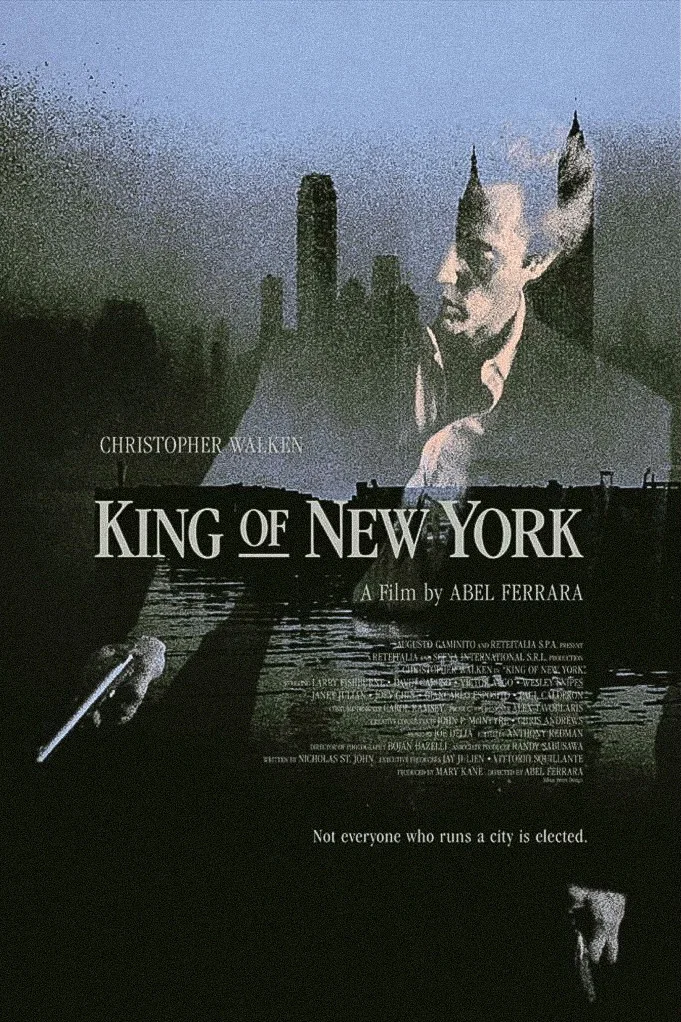
King of New York remains surprisingly underrated when compared with other major gangster films of its era. Released in 1990, it arrived in the shadow of films like Goodfellas, Miller’s Crossing, and later Carlito’s Way, all of which became more firmly established in the gangster canon. Ferrara’s film is rougher, stranger, and less polished, but that is also part of what makes it distinctive.
Rather than focusing on the rise and fall of organized crime in a traditional sense, King of New York is more interested in moral decay, urban neglect, and the blurred line between criminal violence and institutional violence.
Christopher Walken’s Frank White is more ambiguous than many of the genre’s better-known gangsters because he is neither purely monstrous nor conventionally sympathetic. The film’s moody visual style, hip-hop-inflected atmosphere, and almost dreamlike sense of New York give it a character that feels completely different from the classical gangster films of the same period.
While Goodfellas is more technically dazzling and narratively accessible, King of New York is arguably more unsettling because it refuses to offer the audience a stable moral position. Its reputation has grown over time, but it still deserves more discussion as one of the most distinctive American gangster films of the early 1990s.
Frank wants to finance a hospital for impoverished children in the South Bronx. He recognizes that society has neglected people who desperately need medical care.
But the money comes from drug trafficking and murder.
Frank seems sincerely invested in helping his community, yet he has no problem destroying other lives to accomplish that goal. His charitable ambitions coexist with his desire to control New York’s criminal underworld.
His contradiction is fundamental: he wants to repair the damage caused by a system of exploitation while participating in that exploitation himself.
His generosity doesn’t erase his brutality. His brutality doesn’t necessarily make his concern for people with low incomes insincere.
2. The police become what they hate
The detectives begin with a legitimate objective: stopping a dangerous criminal organization.
But their frustration with the legal system leads them to take justice into their own hands. Their willingness to engage in extrajudicial violence mirrors Frank’s belief that his desired outcome justifies whatever methods he uses.
This is one of the film’s most important moral reversals.
Frank believes he can commit murder to create a better world. The detectives believe they can commit murder to eliminate someone who makes the world worse.
Both have appointed themselves judge and executioner.
Roy Bishop, played by Victor Argo, provides an important contrast.
Unlike the younger detectives, Bishop remains restrained despite his exhaustion and frustration.
He recognizes the danger Frank represents, but he also understands that becoming a murderer in pursuit of justice destroys the moral legitimacy of that pursuit.
His character demonstrates that the film isn’t simply arguing that criminals and police are identical. It distinguishes between those who abandon ethical boundaries and those who struggle to preserve them.
What makes Bishop interesting, though, is that he is not presented as a triumphant moral authority. He is tired, compromised by the system he works within, and unable to prevent the people around him from escalating the violence. His morality is therefore less heroic than restrained. He has no grand solution to the city’s corruption, poverty, or criminality; he understands that once the police abandon the distinction between law and vengeance, they surrender the very principle that separates them from Frank.
4. The city itself is morally compromised
Frank’s hospital project raises an uncomfortable question: Why does a drug lord have to offer to finance a hospital for poor children in the first place?
The film presents a city where legitimate institutions fail vulnerable communities while enormous wealth circulates through criminal enterprises.
Frank exploits that failure to portray himself as a savior.
But the tragedy is that his solution reproduces the very violence and exploitation that make those communities suffer.
The film’s critique extends beyond individual criminals to the social environment that allows their power to flourish.
ENDING SPOILERS
Frank’s final moments are particularly revealing.
The supposed King of New York ends up bleeding to death alone in the back of a taxi, surrounded by a city that carries on without him.
He cannot buy redemption, escape the consequences of his violence, or permanently impose his vision on society.
His wealth and power ultimately mean nothing.
The ending also denies the audience the satisfaction of a clean victory for law and order. The police have been devastated, Frank is dying, and the broader conditions that produced the conflict remain unresolved.
The film’s tragedy is that the characters become so consumed with imposing their own visions of justice that they destroy almost everything they claim to value.
Nobody really wins because nobody can escape the consequences of their own contradictions.